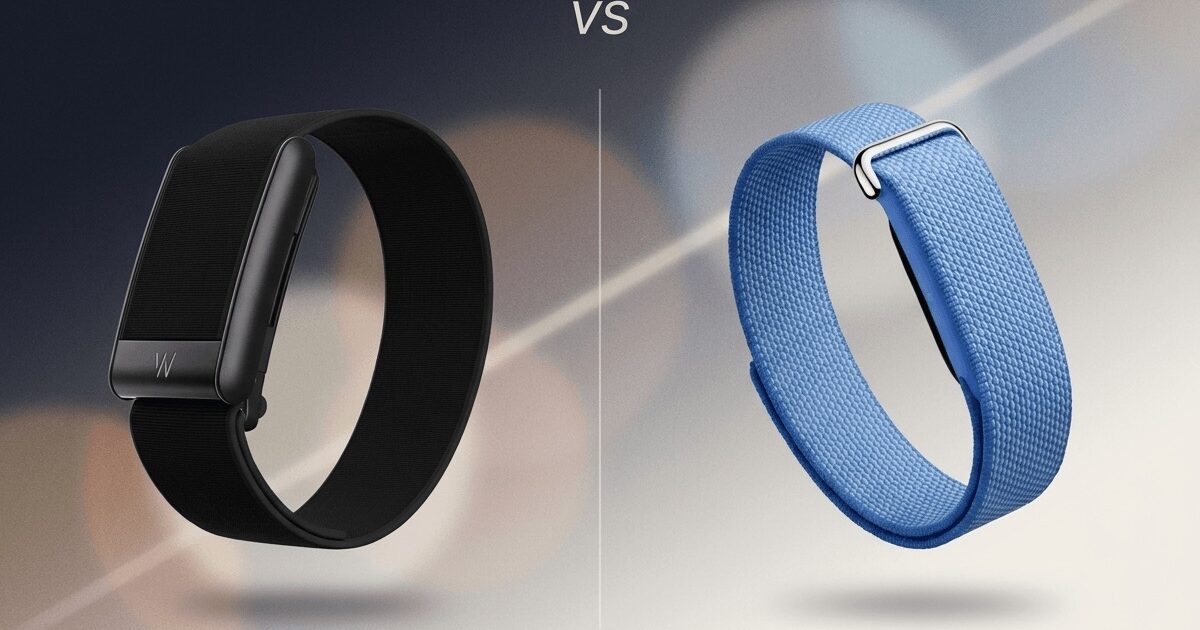
I don’t wear a fitness tracker. I tried Whoop for two weeks back in 2024, kept forgetting to charge it, and quit after showing up to a 5K with a dead strap. So when Google dropped the Fitbit Air last Thursday, a $99 screenless wearable clearly aimed at Whoop’s neck, I read the press release twice and went hunting for spec sheets.
The short version: Google didn’t build a Whoop killer. They built something else. And the something else is more interesting than the headlines suggest.
If you’ve been on the fence about a tracker, or you already own a Whoop and the subscription is starting to grate, this is the post. I’ll break down what’s actually new, what each device does well, and where I think the Fitbit Air will take real market share. And where it won’t.
What Google actually shipped
The Fitbit Air is a tiny screenless pebble you slide into a fabric or silicone band and wear 24/7. It costs $99.99, ships May 26, and includes a three-month trial of Google Health Premium.
The specs that matter:
- 5.2 grams without the band, 12 grams with
- Up to a week of battery life
- Five-minute fast-charge gets you a full day of power
- Water-resistant to 50 meters
- 24/7 heart rate, HRV, SpO2, sleep stages, AFib alerts
- Pairs with the Pixel Watch (wear the watch by day, switch to the Air at night, share one Google Health backend)
- Works with Android 11+ and iOS 16.4+
The bigger story sits underneath the hardware. The Fitbit app becomes the Google Health app on May 19, and the premium tier ships Google Health Coach. That’s a Gemini-powered thing that does workout recommendations and sleep analysis. The genuinely useful trick: you can snap a photo of the gym whiteboard and it’ll log the circuit for you. I’ve spent enough time squinting at hand-written WODs to appreciate that one. Whether the model is good enough to consistently parse messy whiteboard scrawl is a different question, and I haven’t tested it.
One thing the announcement is quiet about: the Air doesn’t track blood pressure, doesn’t have ECG, and has no screen. The screen part is intentional. The other two are real gaps if you’re a “give me every metric” person.
TechCrunch’s writeup has the full hardware details if you want to nerd out further on the form factor.
The Whoop side
Whoop has two devices in market: the WHOOP 5.0 and the WHOOP MG, both shipped in 2025. Same screenless form factor as the Fitbit Air, which is the whole point of the comparison.
Pricing is the unmissable difference. Whoop sells you the membership, not the device:
- One: $199/year (gets you the WHOOP 5.0)
- Peak: $239/year
- Life: $359/year (gets you the WHOOP MG)
The hardware is “free” inside the membership. Stop paying, the device stops working. That’s a different mental model than buying a Fitbit Air outright, and it’s worth sitting with for a second before you commit either way.
Sensor-wise, Whoop has been doing this longer. The 5.0 captures data 26 times per second, lasts 14+ days on a charge, and is 7% smaller than the 4.0. The MG adds ECG and blood pressure estimates. Whoop is calling this “medical-grade”. I’d put a real asterisk on that claim until you’ve seen independent validation, but it’s a real differentiator on paper.
The recovery and strain scores are where Whoop has built its actual moat. Their model for telling you when to push and when to rest is more sophisticated than what Google has shown so far. Athletes who have been on Whoop for years also have years of personalized baselines that the Fitbit Air won’t match for months.
The math
Let me run the five-year cost out, because this is where it gets interesting.
Five years of Whoop One: $199 × 5 = $995.
Five years of Fitbit Air: $99.99 plus optional Google Health Premium at $9.99/mo if you keep it past the free trial. That’s somewhere between $100 and $700 total, depending on whether you keep Premium.
Even if you pay for Premium the whole time, the Fitbit Air is about $300 cheaper over five years. If you treat it as a $99 one-time purchase and skip Premium after the trial, it’s an $895 difference. That’s a flight, a really good pair of running shoes, or roughly three months of an actual gym membership.
So Fitbit wins on price. Easily.
But the Whoop subscription is partly buying you the model. Their recovery score and HRV trend analysis are mature. Google Health Coach is going to need a year or two of real-world data to catch up, even with Gemini behind it. And Whoop’s app, for all its flaws, has a tighter focus on athletic recovery than Fitbit ever has had.
This is the same pattern I noticed when I compared Cursor vs Copilot vs Claude Code for daily coding work: the cheaper option doesn’t always lose, but it loses on the specific axis the more expensive thing was built for. Whoop was built for athletic recovery. Fitbit Air was built for “I want a tiny thing on my wrist that tells me if my heart’s doing something weird.”
Where the Fitbit Air actually wins
Three places, real ones.
Price for someone who isn’t an athlete. If you’re trying to get a baseline read on your sleep and resting heart rate, and you want AFib alerts running quietly in the background, $99 is hard to argue with. You’d burn through that on Whoop in six months.
Battery and form factor for sleep. The 12-gram weight and the screenless design are genuinely better for sleep than a Pixel Watch or an Apple Watch. The fact that you can run a Pixel Watch by day and the Air by night, and they share the same Google Health backend, is a clever play that Apple can’t match without dropping their own subscription rake.
Onboarding for a non-tech-literate parent. This is the one I think Google is actually targeting. If you want to buy your mom a thing that quietly watches her heart, syncs to her phone, and doesn’t require her to remember a subscription she’ll never use, the Fitbit Air is a well-designed answer. Whoop isn’t a product you give your mom.
Where Whoop still wins
If you’re an athlete who treats recovery as a strategy and not a curiosity, Whoop is still the answer. Their training load model is more mature, and the bicep strap option is more accurate during weight training than anything wrist-mounted.
If you want ECG and blood pressure on the wrist today, the WHOOP MG is the only screenless option. The Fitbit Air can’t do either.
One small but real thing: Whoop’s data export is decent. You can pull your raw data and analyze it yourself. I haven’t seen a confirmed answer on whether Google Health will let you do the same. If you’re the kind of person who wants to pipe HRV data into your own dashboard, something I do for clients more often than I should admit on my work page, that matters.
What I’d actually do this week
If you don’t currently own a tracker and you’ve been thinking about it, pre-order the Fitbit Air and skip Whoop. The math makes Whoop hard to justify unless you’re a serious athlete.
If you’re on Whoop and the $199/year is starting to sting, keep it for now and see how Google Health Coach performs after the May 19 app rebrand. If the AI coach lands at even 70% of Whoop’s recovery analysis at a quarter of the cost, the migration is real. Give it three to six months of independent reviews before you cancel.
If you’re on the WHOOP MG specifically, stay where you are. The Fitbit Air doesn’t have ECG or BP. Different product.
I’m probably going to grab a Fitbit Air for the sleep tracking, mostly to see if the AI coach can do anything useful with the data. If it can, I’ll write a follow-up. If it can’t, I’ll write that one too.